


How to Choose the Right TV Unit: Size, Height, and Style Guide

For a standard sofa, a TV unit should be about 46-61cm high, so the centre of the screen lands close to seated eye level (roughly 100-107cm from the floor). Make the unit 20-30% wider than the TV itself: about 147-160cm for a 55" TV and 173-188cm for a 65" TV. Allow 40-50cm of depth, or 30-40cm for a slim unit under a wall-mounted screen.
The steps below cover how to measure, how to check the height against your own sofa and TV, and which type, storage and finish suit your room.
Key Takeaways
- Your TV unit should be 20-30% wider than your TV for balance and stability.
- Measure your actual TV width, not just the diagonal screen size.
- Standard TV unit height is 46-61cm for comfortable viewing.
- Leave 15-30cm of space on each side of the unit.
- Maintain 75-90cm walkway clearance in front.
- Choose storage based on your devices, not just decor.
- Floating units make small rooms feel larger.
- Material affects durability, maintenance, and long-term value.
Step 1 - Measure Your TV and Wall Space Correctly
Measure the TV and the wall before you compare units. Most sizing mistakes start here.
1.1 Measure the Actual Width of Your TV (Not Just Screen Size)
TV sizes are measured diagonally. A 65-inch TV does not mean 65 inches wide.
How to measure the TV:
- Check the manufacturer’s specifications online.
- Measure left to right across the frame.
- Include the stand or feet if you’re not wall-mounting.
TV Unit Width by TV Size
| TV Size | Average TV Width | Recommended Unit Width |
|---|---|---|
| 43” | ~95cm | 115-125cm |
| 50” | ~111cm | 133-145cm |
| 55” | 122cm | 147-160cm |
| 65” | ~145cm | 173-188cm |
| 75” | ~168cm | 203-218cm |
| 85” | ~189cm | 227-246cm |
Screen widths vary by brand, so use the width on your TV's spec sheet. With an 85" screen, a wall-mounted TV over a long, low unit is often easier than finding a freestanding piece wider than 230cm.
1.2 Measure Your Wall Width
Measure the full wall where the unit will sit.
Avoid a wall-to-wall look unless you’re building a custom media wall.
Example:
If your wall is 240cm wide, keep a freestanding unit to about 180-210cm so it does not look wedged in. Go wider only with a built-in media wall.
Renters should avoid oversized pieces that limit future layout flexibility.

1.3 Consider Depth and Walkway Clearance
Depth affects how open your room feels.
- Standard depth: 40-50cm
- Slim profile: 30-40cm, best when the TV is wall-mounted, because a TV on its own stand needs room for its feet
- Walkway clearance: 75-90cm minimum
In narrow apartments, deep units make the room feel cramped. Go slim or floating.
Before you settle on a depth, measure your deepest piece of equipment (a soundbar, games console or set-top box) and add a few centimetres for cables. For reference, the Byron (160cm), Oxford (180cm) and Liverpool (180cm) TV units from Cedora are 45-46cm deep.
Step 2 - Choose the Right Height for Comfortable Viewing
Height determines neck comfort and long-term ergonomics.
2.1 How High Should a TV Unit Be?
Most TV units are 46-61cm high. That range suits a standard sofa, where seated eye level is around 100-107cm from the floor. Lower seating needs a lower unit:
| Seating | Suggested TV unit height |
|---|---|
| Standard sofa (seat about 43-45cm) | 46-61cm |
| Low-profile sofa | 36-46cm |
| Floor cushions or very low seating | 20-36cm |
To check the height for your own TV: measure your seated eye height from the floor, subtract half the height of the screen, then subtract the height of the TV's feet. A 55" screen is about 69cm tall, so with an eye height of 100cm and 7cm feet you get 100 - 34.5 - 7 = about 58cm, inside the usual range.
Cedora's units sit within this range: the Byron 2 Door TV Unit is 55cm high, the Liverpool 180cm unit is 56cm and the Oxford TV Unit is 60cm. Floating units can be mounted at whatever height suits your seating.
2.2 The Eye-Level Rule Explained
The centre of your TV should sit at or slightly below your seated eye level.
Average seated eye level: 100-107cm from the floor.
Too high → neck strain.
Too low → awkward posture.
If you have a low-profile modern sofa, you may need a slightly lower unit.

2.3 TV on Stand vs Wall-Mounted TV
| Setup | Height Control | Flexibility | Visual Cleanliness |
|---|---|---|---|
| TV on Stand | Fixed by unit height | Easy to move | Moderate |
| Wall-Mounted | Fully adjustable | Permanent install | Very clean |
Wall-mounted TVs pair well with floating units for a minimalist look.
Viewing Distance
A common guide is to sit 1.5 to 2.5 times the screen's diagonal away from the TV. For a 55" TV (140cm diagonal) that is roughly 2.1-3.5m from the sofa. If your room is shorter than that, a smaller screen keeps viewing comfortable.
Step 3 - Pick the Best Type of TV Unit
3.1 Freestanding TV Units
Most common option.
Pros:
- Easy setup
- No wall damage
- Moveable
Cons:
- Takes floor space
- Can feel bulky in small rooms
Best for renters and flexible layouts.
3.2 Floating / Wall-Mounted TV Units
Mounted directly to the wall.
Benefits:
- Makes rooms feel larger
- Easier cleaning
- Modern aesthetic
Requires proper wall support (studs or solid backing). Professional installation is recommended.
Many 2026 designs include:
- Integrated LED lighting
- Hidden cable channels
- Ventilated compartments
Floating units visually reduce clutter in small living rooms.
3.3 Built-In or Custom Media Walls
Designed as part of the wall.
Advantages:
- Maximum storage
- Seamless look
Higher cost and permanent. Ideal for homeowners planning long-term.

Step 4 - Plan Storage and Functionality
Think beyond the TV.
4.1 Open vs Closed Storage
| Feature | Open Storage | Closed Storage |
|---|---|---|
| Ventilation | Excellent | Moderate |
| Dust Control | Low | High |
| Visual Clutter | Visible | Hidden |
Games consoles need open air around their vents, so give them an open or ventilated shelf rather than a closed cupboard.
Best approach: combine both.
4.2 Cable Management Solutions
Poor cable management ruins the look.
Look for:
- Pre-cut cable holes
- Rear cable channels
- Removable back panels
- Space for power strips
Advanced setups may use in-wall cable kits to fully hide wires behind plasterboard.
Use Velcro ties instead of plastic zip ties for flexibility.
4.3 Ventilation and Tech Integration
Electronics generate heat.
Ensure:
- Air gap behind devices
- Ventilated shelves
- IR-friendly doors (allow remotes to work through glass)
Modern units may include:
- Integrated LED backlighting (bias lighting reduces eye strain)
- Built-in USB ports
- Wireless charging pads
Choose only features you’ll actually use.
Measured your space and settled on a height? Find a TV unit that fits, below.
Explore Cedora TV Units


Solid Acacia


Liverpool Pine 2 Door 1 Drawer TV Unit 180cm - Black
Solid Pine Frame with Oak Veneer


Solid Acacia


Richmond Pine 2 Drawer TV Unit - Black
Solid Oak Legs & Pine Structure


Liverpool Pine 2 Door 1 Drawer TV Unit 180cm - Natural
Solid Pine Frame with Oak Veneer


Richmond Pine 2 Drawer TV Unit - Natural
Solid Oak Legs & Pine Structure


Liverpool Pine 2 Door TV Unit 140cm - Black
Solid Pine Frame with Oak Veneer


Liverpool Pine 2 Door TV Unit 140cm - Natural
Solid Pine Frame with Oak Veneer
Step 5 - Match Style and Material to Your Interior
5.1 Popular Media Console Styles
- Modern: Clean lines, matte finishes, floating forms
- Mid-century: Tapered legs, warm wood tones
- Minimalist: Handle-less doors, flat panels
- Organic/biophilic: Natural wood, rattan, stone accents
- Contemporary luxe: Fluted panels, travertine tops
5.2 Choosing the Right Material and Finish
| Material | Durability | Cost | Look | Best For |
|---|---|---|---|---|
| Solid Wood | High | High | Warm, natural | Long-term investment |
| Veneer/MDF | Moderate | Moderate | Versatile | Budget-conscious |
| Metal/Glass | Moderate | Moderate | Modern | Contemporary spaces |
| Stone Top (marble/travertine) | High | High | Luxury | Statement rooms |
Matte finishes hide fingerprints better than high gloss.
Fluted or ribbed panels add texture without clutter.
5.3 Sustainable and Quality Considerations
Look for:
- Low-VOC finishes (low chemical emissions)
- E0 or E1 rated boards (the Australian formaldehyde emission classes for MDF and particleboard)
- Solid joinery instead of stapled panels
Higher quality units last longer and reduce replacement costs.
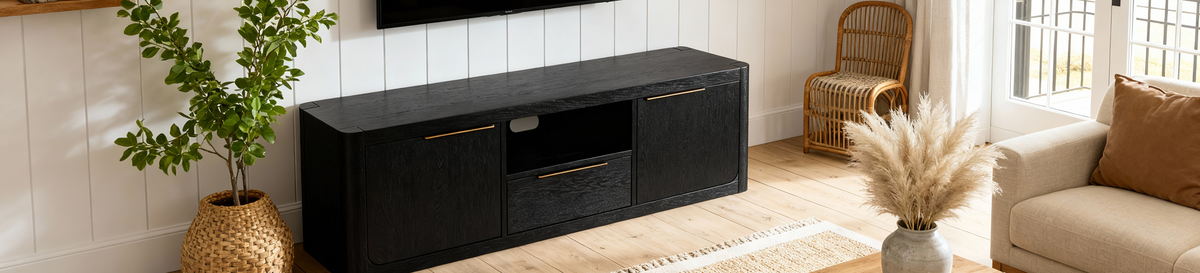
If you're drawn to the warmth of natural timber, the Oxford TV Unit is worth a close look. Built from solid acacia with an MDF back panel, it measures 180cm wide, 45cm deep and 60cm high, which suits a 55" to 65" TV. It's the kind of piece that looks considered without demanding attention.
Small Living Room Solutions
- Choose floating units to free floor space.
- Keep depth to 30-40cm.
- Use vertical panels to draw the eye upward.
- Combine storage with wall shelves.
- Avoid dark bulky pieces in tight rooms.
Slim, elevated designs visually expand space.
Common Mistakes to Avoid
- Choosing a unit narrower than the TV.
- Mounting the TV too high.
- Ignoring ventilation for consoles.
- Blocking walkways.
- Forgetting weight capacity limits.
Quick Checklist Before You Buy
- TV width measured
- Unit is 20-30% wider
- Height within 46-61cm
- Walkway clearance 75-90cm
- Storage fits all devices
- Cable management included
- Wall support checked (for floating units)
- Material matches interior
Conclusion: Choosing the Right TV Unit with Confidence
The right TV unit comes down to three things: correct proportion, functional storage with proper ventilation, and a material that actually suits how you live.
Measure your TV. Measure your wall. Think about how you actually use your space.
A well-chosen TV unit improves comfort, reduces clutter, and elevates your living room instantly.
Measure today before you start browsing. Your future setup depends on it.
Frequently Asked Questions
What is a TV unit?
A TV unit, also known as a media console or entertainment center, is a piece of furniture designed to hold your television and related media devices. It often includes storage for consoles, speakers, and decorative items, serving as a focal point in your living room.
How wide should a TV unit be?
Ideally, your TV unit should be 20-30% wider than your television screen for optimal balance and safety. For example, a 65-inch TV (approx. 145cm wide) would look best on a unit between 173-188cm.
What is the standard height for a TV unit?
The standard height for a TV unit is 46-61cm for a standard sofa. This ensures the TV is at a comfortable viewing height, usually with the centre of the screen around eye level when seated.
Should a TV unit be wider than the TV?
Yes, a TV unit should generally be wider than the TV. A unit that is 20-30% wider provides better visual balance, stability, and space for soundbars or decorative items on either side, preventing the setup from looking cramped.
What's the difference between a TV unit and a TV stand?
While often used interchangeably, a TV stand is typically a simpler, lower piece of furniture designed primarily to hold the TV. A TV unit is often larger, offers more storage, and can be more decorative, sometimes referred to as a media console or entertainment center.
How do I choose the right size TV unit for my living room?
Measure your wall space and the width of your TV. Ensure the unit fits comfortably on the wall with clearance on the sides, and is 20-30% wider than your TV. Consider the distance to your seating for comfortable viewing and walkway clearance.
What are the benefits of a floating TV unit?
Floating TV units are wall-mounted, saving floor space and making rooms appear larger and more modern. They offer a clean, minimalist look and can be positioned at an ideal ergonomic height for viewing.
How important is cable management for a TV unit?
Cable management is crucial for a clean and aesthetically pleasing setup. Good TV units feature cable holes, hidden channels, or removable back panels to conceal wires, preventing clutter and enhancing the overall look of your entertainment area.
What materials are best for TV units?
Durable materials like solid wood, veneers, MDF, metal, and glass are common. Natural wood offers warmth, while metal and glass lend a modern feel. Stone or marble tops provide a luxurious, scratch-resistant surface. Consider material that matches your interior style.
How do I determine the right height for my TV?
The ideal height places the center of your TV screen at or slightly below seated eye level, typically around 100-107cm from the floor. This prevents neck strain and ensures comfortable viewing. For wall-mounted units, this height dictates the console's placement.
What height TV unit do I need for a 55-inch TV?
For a 55-inch TV on a standard sofa, a unit about 50-60cm high keeps the centre of the screen near seated eye level. Choose a unit 147-160cm wide so it extends 20-30% beyond the screen.
What are the typical dimensions of a TV unit in cm?
Freestanding TV units are usually 46-61cm high and 40-50cm deep, with slim units at 30-40cm deep. Common widths are 140cm, 160cm and 180cm, which suit TVs from about 43 to 65 inches.
Stay in the loop
Get styling ideas and early access to new arrivals, straight to your inbox.